

Backlinks remain one of the most discussed parts of SEO, but the way you acquire them matters far more than simply increasing the number of links pointing to your website.
A website with 1,000 backlinks is not automatically stronger than a website with 100. If those 1,000 links come from unrelated websites, low-quality directories, link farms, or pages created only to sell links, they may contribute very little to long-term SEO performance. On the other hand, a handful of genuinely relevant links from trusted publications, industry websites, podcasts, or authoritative resources can be considerably more valuable.
So, what is a quality backlink?
A quality backlink is generally a link from a relevant and trustworthy website that naturally references your content because it provides useful information, evidence, expertise, or a resource worth sharing. The best links make sense to a real reader even if search engines did not exist.
That is the mindset to keep throughout your link-building strategy.
What Is a Backlink?
A backlink is a link from another website to a page on your website. Search engines can use links as signals when discovering and evaluating web pages.
For example, imagine you publish an original study about ecommerce conversion rates. An industry publication writes an article about ecommerce trends and references your research with a link. That is a much more meaningful backlink than a random website adding your homepage to a page containing hundreds of unrelated links.
There are several factors that can influence the value of a backlink:
- Relevance of the linking website
- Authority and trust of the referring domain
- Context surrounding the link
- Quality of the linking page
- Whether the link is editorially earned
- Placement of the link within useful content
- Anchor text
- Whether the link is followed, sponsored, or otherwise qualified
- The overall quality of the website
This is why simply counting backlinks can be misleading.
Why Quality Matters More Than Quantity
One of the easiest mistakes in SEO is assuming that more links automatically mean better rankings.
Suppose Website A has 2,000 backlinks, but most come from unrelated directories and low-quality sites. Website B has 150 backlinks, but those links come from respected publications, specialist blogs, podcasts, universities, industry organizations, and relevant resources.
Website B may have the stronger backlink profile.
This is particularly important for competitive searches. A competitor may appear to have thousands of links, but when you investigate the actual backlink profile, many may be duplicate links, sitewide links, weak directory listings, nofollow links, or links from pages that have little relevance.
The real question is not:
“How many backlinks does my competitor have?”
It is:
“Which backlinks are actually helping my competitor, and why did those websites choose to link to them?”
That question gives you a much more useful starting point.
Start With a Backlink Gap Analysis
Before building new links, examine what is already working in your industry.
Identify several competitors that rank well for your target keywords. Then analyze their backlink profiles using an SEO tool.
Look for patterns such as:
- Websites that repeatedly link to competitors
- Industry publications
- Resource pages
- Relevant directories
- Guest contribution opportunities
- Podcast websites
- Statistics and research pages
- Business associations
- Local organizations
- News publications
- Industry-specific blogs
- Linkable research or data assets
Do not simply copy every link you find.
Instead, classify the opportunities.
For example, if five competitors have links from the same industry publication, that publication may be worth researching. If a competitor has hundreds of links from unrelated websites that clearly exist only for SEO purposes, copying those links is unlikely to be a good strategy.
A backlink gap analysis should tell you where credible opportunities exist, not give you a checklist of links to reproduce blindly.
Create Content People Actually Want to Reference
The most sustainable link-building strategy begins with the content itself.
Nobody has a strong reason to link to a generic article that says exactly the same thing as hundreds of other pages.
Ask yourself:
Why would another website link to this page instead of simply explaining the topic themselves?
That question can dramatically improve your content strategy.
Some content formats naturally attract more links than others.
Original Research
Original research is one of the strongest forms of linkable content.
You could survey customers, analyze industry data, compare thousands of products, study search results, publish an annual report, or analyze publicly available datasets.
For example, instead of writing another article titled “SEO Statistics,” you could conduct your own analysis of 1,000 ranking pages and publish the findings.
Other websites now have a reason to reference your work.
Statistics and Data
People frequently search for statistics to support their own articles, presentations, reports, and social posts.
If you create a well-organized collection of reliable statistics, you can attract links over time.
Even better, produce original statistics rather than simply copying statistics from another website.
Free Tools
Interactive tools can become powerful linkable assets.
Depending on your industry, this could be:
- ROI calculators
- Mortgage calculators
- SEO tools
- Cost estimators
- Comparison tools
- Generators
- Templates
- Checklists
- Planning tools
A useful tool gives publishers a practical reason to reference your website.
Original Visual Assets
Charts, diagrams, maps, infographics, illustrations, and original screenshots can also earn backlinks.
The important word is original.
Simply turning information from someone else’s article into an infographic does not necessarily give you a competitive advantage. Try to provide your own analysis, examples, data, or visual interpretation.
Use Digital PR to Earn High-Quality Links
Digital PR can be one of the most effective ways to acquire authoritative backlinks without directly paying a publisher for placement.
The basic idea is simple:
Create something interesting enough that journalists, editors, bloggers, or industry publications want to mention it.
This could include:
- Original research
- Industry surveys
- Expert commentary
- New data
- Consumer trends
- Expert predictions
- Interesting company studies
- Unique product data
- Newsworthy findings
For example, if you operate a cybersecurity company, you could analyze thousands of publicly reported security incidents and publish a report identifying the most common vulnerabilities.
Journalists writing about cybersecurity now have a source they can reference.
That is much stronger than sending hundreds of generic outreach emails asking websites to “please add my link.”
Guest Posting Still Has a Place
Guest posting is often criticized because it has been abused.
Publishing hundreds of low-quality articles on unrelated websites purely to manipulate rankings is very different from contributing genuinely useful content to relevant publications.
A good guest post should satisfy three people:
- The publication’s readers
- The publication’s editor
- Your own audience
Before approaching a website, check whether the publication is genuinely relevant to your industry.
Then study its existing content.
What subjects does it cover?
What kind of writing appeals to its readers?
Which topics have already been discussed?
What valuable perspective can you offer that isn’t already present?
Instead of pitching:
“Can I submit a guest post with a backlink?”
pitch an actual article idea that solves a problem for the publication’s readers.
The backlink becomes a natural part of the contribution rather than the entire purpose of the relationship.
Build Relationships With Industry Publications
Some of the strongest links come from relationships rather than automated outreach.
If you regularly interact with editors, journalists, podcast hosts, researchers, event organizers, and other professionals in your niche, opportunities can appear naturally.
For example, you might:
- Comment thoughtfully on industry discussions
- Share useful research
- Introduce people to relevant experts
- Attend conferences
- Participate in industry communities
- Speak at events
- Join professional associations
- Appear on podcasts
- Contribute expert quotes
Over time, people become familiar with your name and expertise.
That makes outreach much easier.
A cold email saying “please link to my article” is easy to ignore. A person you have previously interacted with who sends genuinely useful research is much harder to overlook.
Use Podcasts to Earn Relevant Links
Podcasts are an underrated link-building opportunity.
When you appear as a guest on an industry podcast, the host often creates a guest page containing information about you and your business. That page may link to your website.
The value is not limited to the backlink.
A relevant podcast appearance can also generate:
- Brand exposure
- Referral traffic
- New relationships
- Social media mentions
- Content for your own channels
- Authority within your niche
Podcast platforms may provide additional visibility as well, although you should not build the strategy around the assumption that every platform link carries significant SEO value.
The real benefit is the combination of relevance, exposure, credibility, and potential referral traffic.
Look for Resource and Link-Worthy Pages
Many websites maintain resource pages that link to useful external websites.
For example:
- “Best SEO Resources”
- “Small Business Tools”
- “Recommended Marketing Resources”
- “Useful Ecommerce Guides”
- “Industry Statistics”
- “Best Educational Websites”
If you have genuinely useful content that belongs on one of these pages, you can contact the site owner.
But there is an important distinction.
Do not ask hundreds of websites to add a random homepage link.
Find pages where your resource genuinely improves the reader’s experience.
That makes your outreach more relevant and increases your chances of success.
Make Your Content Easy to Cite
One of the simplest ways to attract backlinks is to make your content easy for other writers to reference.
Consider including:
- Clear statistics
- Original research
- Expert quotes
- Short definitions
- Data tables
- Charts
- Methodology
- Sources
- Original examples
- Downloadable resources
For example, instead of hiding an important statistic inside a 2,000-word paragraph, create a clearly labeled section explaining the number and its source.
A writer researching the topic can quickly understand the information and decide whether it is worth citing.
This is particularly effective for research-based content.
Use HARO-Style Expert Opportunities
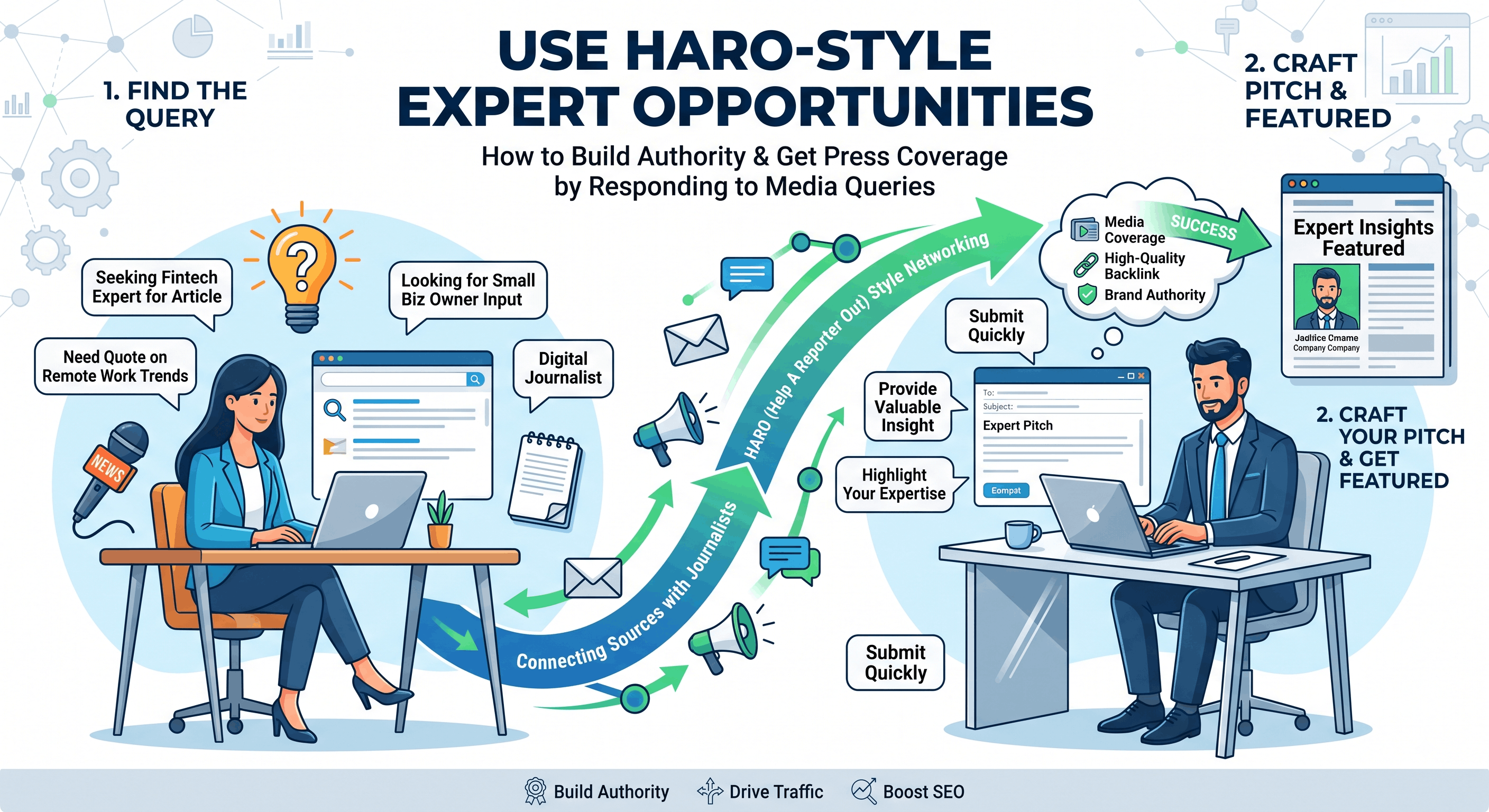
Platforms and communities that connect journalists with experts can provide excellent PR opportunities.
The process is usually straightforward:
- A journalist requests expert commentary.
- You respond with a useful answer.
- The journalist selects relevant responses.
- Your expertise may be included in the published article.
- The publication may link back to your website.
The downside is that these opportunities can be time-consuming and competitive.
You also cannot control exactly where your link appears or what anchor text the publisher uses.
But that is not necessarily a problem.
Natural backlink profiles should not consist entirely of carefully controlled commercial anchor text.
Don’t Ignore Unlinked Brand Mentions
Sometimes websites mention your company, product, founder, research, or content without linking to you.
These are potential link opportunities.
You can monitor brand mentions and identify pages where a link would genuinely help readers.
Then contact the publisher with a simple request.
For example:
Thanks for mentioning our research in your article. If useful for your readers, you could also link the study here so they can review the original data.
This approach is often easier than asking a completely unfamiliar website to publish a new article.
Consider Broken Link Building

Broken link building involves finding links on other websites that no longer work and suggesting a relevant replacement.
The process looks like this:
Find broken link → Identify the original topic → Create or locate a better resource → Contact the publisher → Suggest your resource
The key is relevance.
Your replacement should genuinely match what the broken link was supposed to provide.
If the original page discussed ecommerce checkout optimization, sending the publisher a generic homepage is unlikely to be useful.
A closely matched replacement resource has a much stronger case.
Build Partnerships, Not Just Links
Partnerships can create recurring opportunities for legitimate mentions and links.
Think about businesses that serve the same audience without being direct competitors.
For example, a web design company might partner with:
- SEO consultants
- Copywriters
- Branding agencies
- Hosting companies
- Marketing consultants
- Software providers
- Business communities
These relationships can lead to interviews, case studies, collaborative content, webinars, podcasts, events, and resource pages.
The backlink is then a byproduct of a real business relationship.
That is usually a healthier foundation than purchasing hundreds of unrelated links.
What About Link Exchanges?
Link exchanges can be tempting because they are relatively straightforward.
Two websites agree to link to each other, often in exchange for exposure or another link.
The problem comes when the entire strategy becomes a systematic attempt to manipulate search rankings.
If you are considering any type of reciprocal linking, focus on genuine relevance and user value rather than building large networks of artificial exchanges.
For example, two complementary businesses mentioning each other because they genuinely serve the same audience is very different from creating dozens of websites solely to exchange links.
Be Careful With Paid Backlinks
There is a huge market for paid backlinks.
You will find services offering:
- 100 backlinks for a few dollars
- High-DR guest posts
- PBN links
- Automated profile links
- Directory packages
- Bulk web 2.0 links
- “Guaranteed ranking” packages
The cheap offers can be particularly attractive when you are starting a new website.
But hundreds of inexpensive links are not necessarily better than a small number of strong editorial links.
If a service promises thousands of links for almost no money, ask yourself how those links can possibly be individually researched, written, placed, and maintained at that price.
They usually cannot.
The goal should not be to spend a specific amount such as $1,000 simply because someone says you need to buy backlinks. Your budget should depend on your industry, competition, content quality, and available resources.
Some businesses may benefit from investing in PR and content instead. Others may use carefully selected paid placements where appropriate and compliant with search-engine guidelines.
The important thing is to understand exactly what you are purchasing.
Avoid Cheap Fiverr-Style Link Packages
Bulk backlink packages promising hundreds or thousands of links for a few dollars should be approached with extreme caution.
The seller may use automated software, networks of low-quality sites, spun content, profile pages, or irrelevant directories.
Even if those links are indexed, indexing does not mean they are valuable.
Before purchasing a link-building service, ask:
- Where will the links be placed?
- Are the websites relevant to my industry?
- Are the pages real and useful?
- Is the content original?
- How are the sites selected?
- Are the links editorially appropriate?
- Will the links be disclosed where necessary?
- Can I review examples before purchasing?
- Does the provider guarantee rankings?
A reputable provider should be able to explain the process clearly.
Do Not Obsess Over DoFollow Links
A natural backlink profile can contain different types of links.
Some links may be followed. Others may use nofollow, sponsored, or other link attributes.
Do not reject a valuable publication simply because the link does not provide the exact link attribute you expected.
A mention from a respected publication can still send referral traffic, increase brand awareness, create secondary links, and put your business in front of potential customers.
SEO is not just about extracting ranking signals from every link.
Think about the entire value of the mention.
Use Social Media to Increase Content Visibility
Social platforms do not replace traditional link building, but they can help your content get discovered.
You might distribute your content through:
- YouTube
- TikTok
- X
- Industry communities
The goal is not to post a link everywhere and expect those links to transform rankings.
Instead, use social distribution to put useful content in front of people who might eventually reference it.
A journalist discovers your research on social media.
A blogger sees your original study.
A podcast host discovers your expertise.
An industry expert shares your report.
That exposure can eventually result in editorial backlinks.
Create a Content Matrix
A strong link-building strategy should be connected to your broader content strategy.
Build a content matrix around the questions your audience actually asks.
For example:
What Is Content
Explain important concepts clearly.
Examples:
- What is technical SEO?
- What is domain authority?
- What is link building?
- What is topical authority?
How-To Content
Show people how to accomplish something.
Examples:
- How to audit backlinks
- How to conduct competitor research
- How to recover lost backlinks
Comparison Content
Help users make decisions.
Examples:
- SEO tools compared
- Guest posting vs digital PR
- In-house SEO vs agency SEO
Data Content
Publish information others can reference.
Examples:
- SEO industry statistics
- Search behavior research
- Ecommerce benchmarks
This approach creates a larger ecosystem of content instead of publishing disconnected articles.
Optimize the Page Before Building Links

Backlinks cannot compensate for a poor website.
Before investing heavily in link acquisition, make sure the target page is worth sending visitors to.
Check:
- Page title
- Meta description
- Heading structure
- Search intent
- Content quality
- Internal links
- Page speed
- Mobile usability
- Images
- Structured data where appropriate
- Clear calls to action
- Overall user experience
Imagine successfully earning a backlink from a major publication.
Hundreds of visitors arrive.
The page loads slowly, provides little useful information, and has no clear next step.
You have wasted a valuable opportunity.
Link building and on-page SEO should support each other.
Internal Linking Is Part of the Strategy
External backlinks may point to a particular article, but your internal links help distribute relevance throughout your own website.
Suppose you earn a strong backlink to a detailed guide about keyword research.
That guide could naturally link to:
- Your keyword research service
- A technical SEO guide
- A content strategy article
- A case study
- Related tutorials
This creates a connected website structure.
When publishing new content, look for older relevant pages that should be linked from it. Also revisit important existing pages and add internal links to newer resources where appropriate.
Track More Than Backlink Counts
A successful link-building campaign should be measured using several indicators.
Track:
- Referring domains
- Relevant referring domains
- Organic traffic
- Rankings
- Referral traffic
- Brand mentions
- Leads
- Conversions
- Lost backlinks
- New backlinks
- Link quality
- Target-page performance
A backlink that produces 50 relevant visitors and two customers may be more valuable to your business than 100 links that generate zero visitors.
SEO metrics are useful, but business outcomes matter too.
Quality Backlinks Require a Mix of Tactics
There is no universal backlink-building method that works for every industry.
An ecommerce brand may benefit from product reviews, partnerships, digital PR, creators, and useful tools.
A local business may benefit from local organizations, community websites, suppliers, chambers of commerce, local news, and sponsorships.
A SaaS company may focus on integrations, research, comparison pages, podcasts, webinars, and industry publications.
A professional services company may benefit from expert commentary, case studies, associations, conferences, and thought leadership.
This is why the right strategy depends heavily on your niche, audience, competitors, resources, and goals.
Time vs. Money: Choose Your Advantage
One practical way to think about link building is to consider your two biggest resources: time and money.
If you have a small budget but plenty of expertise and time, you can invest in:
- Expert outreach
- Digital PR
- Guest contributions
- Podcast appearances
- Original research
- Relationship building
- Community participation
If you have a larger budget, you might invest in:
- Original studies
- Professional PR campaigns
- Data assets
- Interactive tools
- Content production
- Industry events
- Specialist outreach
But spending more money does not automatically produce better links.
A $5,000 campaign with a poor strategy can fail.
A well-executed research project created by a small team can earn links for years.
A Practical Quality Backlink Strategy
If you are starting from scratch, you do not need to attempt everything at once.
A sensible process could look like this:
Step 1: Audit Your Existing Backlinks
Find out which websites already link to you and identify potentially harmful or irrelevant patterns.
Step 2: Study Competitors
Look for recurring referring domains and identify legitimate opportunities.
Step 3: Build Linkable Assets
Create research, tools, statistics, guides, templates, or other resources that provide a genuine reason to link.
Step 4: Identify Relevant Websites
Build a prospect list based on relevance rather than domain metrics alone.
Step 5: Start Outreach
Contact editors, publishers, journalists, podcast hosts, organizations, and businesses with a useful and personalized reason for contacting them.
Step 6: Build Relationships
Do not treat every contact as a one-time link transaction.
Step 7: Promote Your Best Content
Use email, social media, communities, PR, and industry networks to increase visibility.
Step 8: Measure Results
Monitor rankings, traffic, referring domains, referral traffic, leads, and conversions.
Step 9: Improve What Works
Do additional podcasts if your appearances regularly result in high-quality traffic and mentions.
Create another study if a specific kind of investigation generates links.
Don’t waste time on generic guest posts if they don’t yield any results.
The strategy should evolve based on evidence.
The Biggest Mistakes to Avoid
Buying Links in Bulk
Large quantities of cheap links can create more problems than opportunities.
Focusing Only on Domain Metrics
DR, DA, and similar metrics are useful for research, but they are not the complete definition of a quality website.
Using Exact-Match Anchor Text Everywhere
Natural links use different words and phrases. Trying to force the same commercial keyword into every backlink can make the profile look unnatural.
Ignoring Relevance
A link from a high-metric website that has nothing to do with your industry may be less useful than a link from a smaller but highly relevant publication.
Publishing Low-Quality Guest Posts
Guest posting works best when the article genuinely deserves to be published.
Automating Everything
Outreach is about communication. Excessive automation often produces generic messages that editors can recognize immediately.
Measuring Success by Links Alone
The ultimate objective is not collecting links. It is improving visibility, attracting the right audience, building authority, and generating business results.
Final Thoughts
Acquiring quality backlinks is not about finding a secret website where you can order 1,000 links overnight.
The strongest link-building campaigns usually combine useful content, relationships, digital PR, expert contributions, relevant publications, original research, partnerships, and consistent promotion.
The most important shift is to stop thinking:
“How can I get a backlink?”
and start thinking:
“What can I create or contribute that another website would genuinely want to reference?”
That change in mindset makes the entire process more sustainable.
A relevant editorial mention from an industry publication, a podcast appearance, an original research report cited by journalists, or a genuinely useful resource linked from a trusted website can continue generating value long after the link is acquired.
There is no fixed number of backlinks that guarantees a first-page ranking. Competition, search intent, content quality, technical SEO, website authority, and many other factors influence organic performance.
So build links with a long-term mindset.
Create something useful. Put it in front of the right people. Build relationships in your industry. Earn mentions where they make sense. Measure what produces results, and invest more heavily in the tactics that consistently work.
That is how you build a backlink profile that supports SEO rather than simply making a backlink counter go up.


